Skip to content

Finding the right hairstyles for balding men is one of the most common requests I get at my salon, and it’s also the one that changes a client’s confidence the fastest. Hair loss happens to most of us — the American Academy of Dermatology notes that hereditary hair loss affects roughly 50 million men in the United States alone. The good news? The right cut can make thinning hair look intentional, sharp, and completely modern.
In my ten-plus years behind the chair, I’ve learned that balding men don’t need to hide anything. They need a haircut that works with their hair loss pattern instead of fighting it. Short, textured cuts like the ones in our guide to short haircuts for men almost always beat long, wispy styles, and the right taper haircut can reduce the contrast that makes thinning obvious.
Below are the 25 best styles I recommend to real clients, grouped by hair loss pattern: receding hairline, thinning crown, overall thinning, and advanced balding. For each one, you’ll get face shape compatibility, maintenance needs, and the exact words to say to your barber.
How I Help Clients Choose a Haircut for Thinning Hair
Before we get to the styles, here’s the framework I use during every consultation with a client experiencing male pattern baldness.
First, identify your hair loss pattern. Androgenetic alopecia usually follows the Norwood scale, and your pattern decides your best options:
- Receding hairline: The hairline pulls back at the temples first. Forward-styled cuts and short fringes are your friends.
- Thinning crown: A bald spot forms at the back. Styles with length on top that can be directed backward or over the crown work best.
- Overall thinning: Hair density drops everywhere. Uniform short cuts with texture create the illusion of fullness.
- Advanced balding: When coverage runs out, the boldest move is embracing it with a skin fade, clean shave, or beard-focused look.
Second, follow the contrast rule. The bigger the difference between your fullest hair and your thinnest area, the more visible the hair loss. Short sides with modest top length reduce that contrast instantly. That’s why nearly every cut on this list keeps the sides tight.
Third, respect your face shape. A cut that flatters a round face can wash out an oblong one. If you’re not sure what shape you have, our guides to hairstyles for rectangle faces and flattering styles for oblong face shapes break down how to measure it in a mirror.
Best Hairstyles for Balding Men with a Receding Hairline
These eight cuts minimize temple recession and make a mature hairline look deliberate rather than accidental.
1. Buzz Cut
The buzz cut is the single most reliable haircut for balding men, and it’s the one I recommend most often.
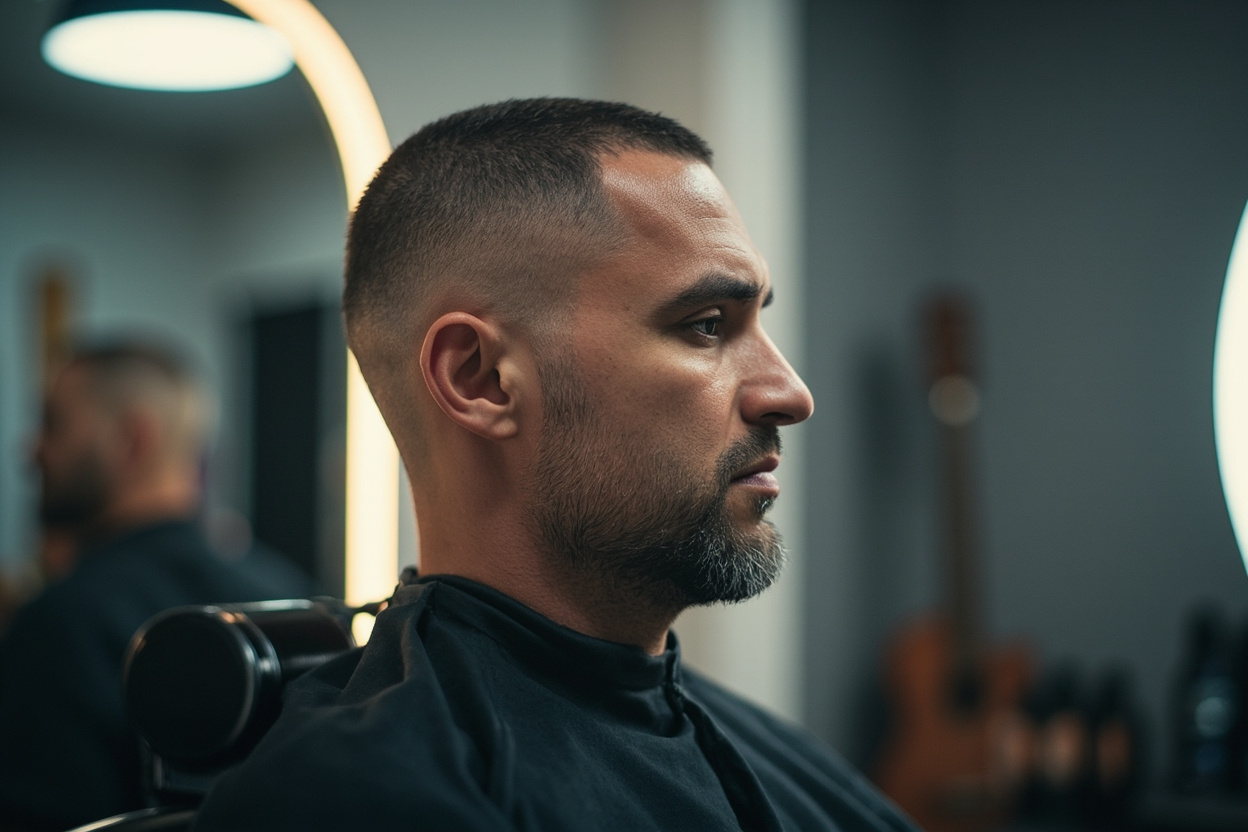
When you clip everything down to a uniform length, the contrast between your receding hairline and the rest of your hair almost disappears. There’s no comb-over to maintain, no wind to ruin your styling, and no bad hair days. Fine hair texture actually looks denser at this length because every hair stands upright instead of lying flat. The buzz cut also puts the focus on your jawline and eyes, which is exactly where you want attention to go. Pair it with light stubble and the whole look reads athletic and intentional. One of my clients, a teacher in his late thirties, fought his hairline for two years with longer styles before letting me buzz it. He told me afterward it was the first time in years a haircut made him look younger instead of thinner.
Best For
- Face Shape: Oval, square, and angular faces (strong jawlines shine here)
- Hair Type: All textures, especially fine or thinning hair
- Hair Length: #1 to #3 clipper guard (3-10mm)
- Age Range: All ages
- Occasion: Everyday, athletic, low-effort professional
Maintenance & Styling
- Touch-up: Every 2-3 weeks
- Styling Time: 0 minutes
- Products Needed: Scalp moisturizer, SPF for sun exposure
- Difficulty: Easy
How to Ask Your Barber
Say: “Give me a buzz cut with a #2 guard all over, and blend the edges so nothing looks harsh.” If your hairline recession is uneven, ask your barber to skip the sharp line up and leave the hairline natural — a razor-straight edge draws attention to the recession.
Pro tip from my salon: Go one guard shorter than feels comfortable the first time. Thinning hair looks fullest when the buzzed length matches the density of your thinnest area, not your thickest.
2. Crew Cut
The crew cut gives you the camouflage of a short cut without giving up styling on top.

This classic military cut keeps the sides short and leaves about an inch on top, gradually shortening from front to back. That front length is the secret weapon for a receding hairline: brushed slightly forward or up, it softens the temples and reduces the visible depth of the recession. The crew cut suits nearly every professional environment, and it’s forgiving between barber visits. Because the top stays short, fine hair holds its shape without heavy product — a light matte paste is all you need. It’s also one of the most flexible cuts on this list, pairing well with a low taper fade on the sides if you want a more modern finish.
Best For
- Face Shape: Oval, round, heart
- Hair Type: Straight or wavy, fine to medium density
- Hair Length: 1-1.5 inches on top
- Age Range: All ages
- Occasion: Office, formal, everyday
Maintenance & Styling
- Touch-up: Every 3-4 weeks
- Styling Time: 2 minutes
- Products Needed: Matte paste or light clay
- Difficulty: Easy
How to Ask Your Barber
Say: “Crew cut — short taper on the sides, about an inch on top, shorter toward the crown, and keep the front long enough to brush up.” Mention your hairline and ask them to blend the temples softly instead of squaring them off.
Pro tip from my salon: Blow-dry the front upward for ten seconds before applying product. Lifting the roots at the hairline makes temple recession noticeably less visible from the front.
3. Textured Crop (French Crop)
The textured crop is the most requested cut in my chair for men in the early stages of a receding hairline.
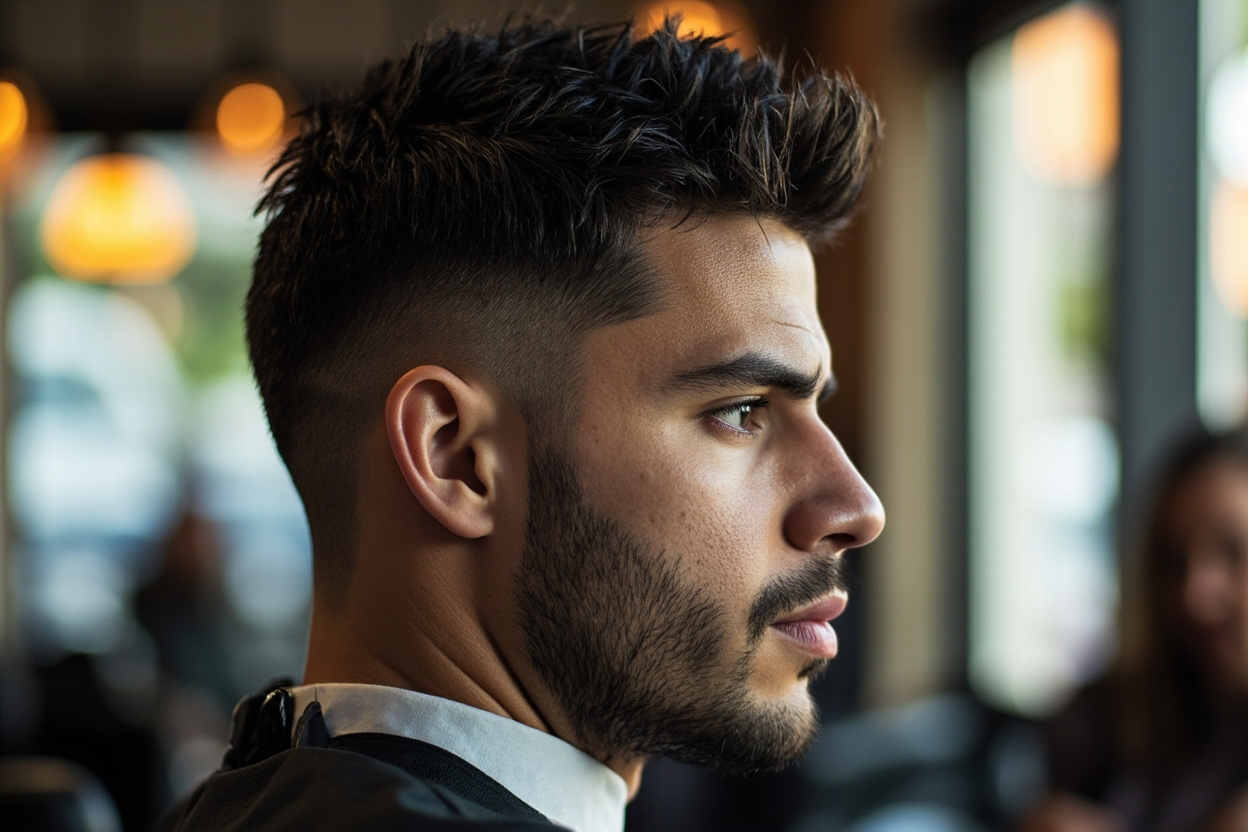
Here’s why it works: the short, forward-brushed fringe sits directly on the hairline and hides temple recession completely. Nobody can see what’s behind a fringe. The choppy, point-cut texture on top creates shadow and depth, which makes thin hair read as thick hair. Meanwhile, a skin fade or taper on the sides keeps the whole silhouette crisp. The French crop variation keeps the fringe blunt and horizontal, while the messier crop version breaks it up for a softer finish. If you have a cowlick complicating your fringe, the techniques in our cowlick hairstyles guide pair perfectly with this cut.
Best For
- Face Shape: Oval, oblong, round (shortens long faces nicely)
- Hair Type: Straight, wavy, or slightly curly
- Hair Length: 1.5-2 inches on top, short fringe
- Age Range: 20s-50s
- Occasion: Everyday, creative workplaces, nights out
Maintenance & Styling
- Touch-up: Every 3-4 weeks
- Styling Time: 3 minutes
- Products Needed: Sea salt spray, matte clay
- Difficulty: Easy
How to Ask Your Barber
Say: “Textured crop with a mid fade. Leave the fringe heavy and cut it just above my hairline, with plenty of point cutting through the top for texture.” The phrase “point cutting” tells your barber you want choppy, density-building texture rather than a flat, blunt finish.
Pro tip from my salon: Apply sea salt spray to damp hair and rough-dry it with your fingers before adding clay. The spray doubles the visual thickness of fine fringes without any greasy weight.
4. Caesar Cut
The Caesar cut has been solving receding hairlines since ancient Rome — Julius Caesar wore it for exactly that reason.
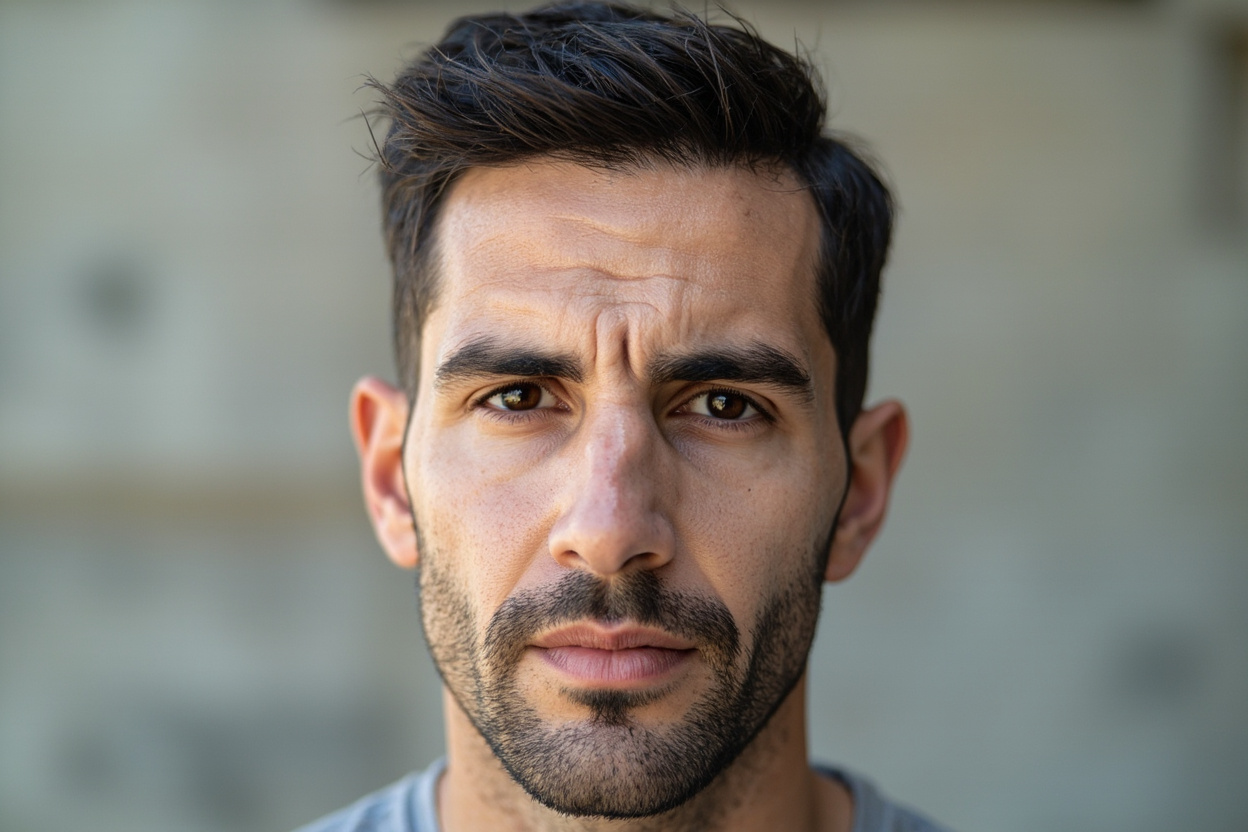
The Caesar keeps everything one short, uniform length — usually one to two inches — with the whole top combed forward into a straight, blunt mini-fringe. That forward direction is the entire trick: hair moves toward the recession and covers it, instead of being pulled back to expose it. Because the length is uniform, the Caesar is nearly maintenance-free and grows out gracefully. It’s a strong pick for men whose recession is uneven, deeper on one temple than the other, since the fringe line hides both sides equally. My Latino clients often ask for the sharper, faded version of this cut, which you can see in our Mexican Caesar Edgar guide.
Best For
- Face Shape: Oval, round, square
- Hair Type: Straight or wavy, medium density
- Hair Length: 1-2 inches all over
- Age Range: All ages
- Occasion: Everyday, casual, office
Maintenance & Styling
- Touch-up: Every 4-5 weeks
- Styling Time: 1-2 minutes
- Products Needed: Light matte pomade
- Difficulty: Easy
How to Ask Your Barber
Say: “Caesar cut, about an inch and a half all over, everything combed forward with a straight fringe. Taper the sides but don’t fade them too high.” A high fade with a Caesar can expose thin temples, so keep the fade low or mid.
Pro tip from my salon: Comb the fringe forward while your hair is still damp, then let it air dry. Heat styling a Caesar tends to make the fringe separate and show the hairline underneath.
5. Messy Textured Fringe
If the Caesar feels too structured, the messy textured fringe delivers the same hairline coverage with a relaxed, modern attitude.
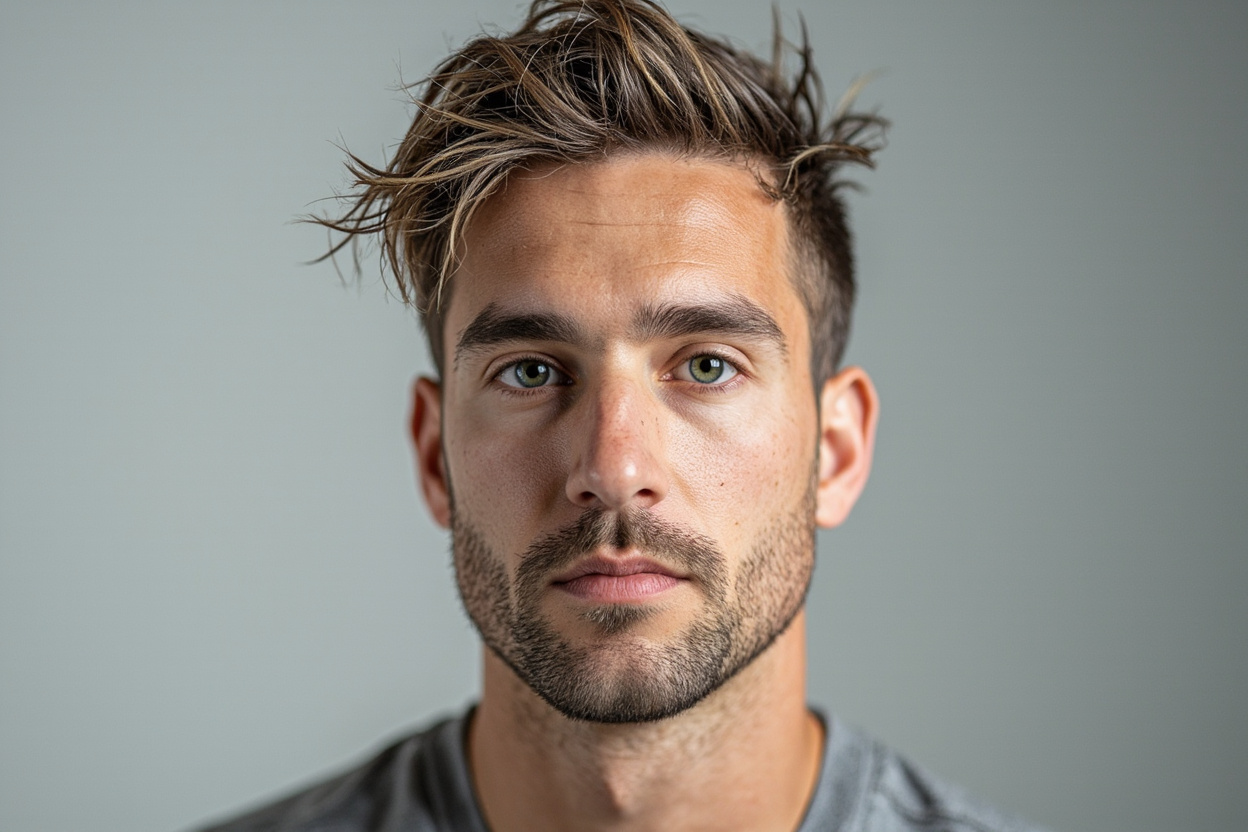
This cut leaves two to three inches on top, chopped into with texturizing shears, then styled forward and slightly to one side with deliberate messiness. The uneven, broken-up fringe line is the key detail: a soft, irregular edge blurs the hairline underneath it, while a razor-sharp straight fringe would only highlight it. The messy finish also adds visual volume, because separated pieces of hair cast shadows that make density hard to judge. This is my go-to recommendation for men in their twenties and thirties who caught their recession early and want something that doesn’t look like a “hair loss haircut” at all.
Best For
- Face Shape: Oval, oblong, heart
- Hair Type: Straight, wavy, or curly with texture
- Hair Length: 2-3 inches on top
- Age Range: 20s-40s
- Occasion: Casual, creative, social
Maintenance & Styling
- Touch-up: Every 4-5 weeks
- Styling Time: 4-5 minutes
- Products Needed: Sea salt spray, texturizing powder
- Difficulty: Medium
How to Ask Your Barber
Say: “Leave two to three inches on top with heavy texturizing, low taper on the sides, and cut the fringe soft and broken — no hard lines. I want to wear it forward and messy.”
Pro tip from my salon: Texturizing powder at the roots is the single best product for this cut. A dime-sized sprinkle gives fine hair grip and lift that lasts all day without looking styled.
6. Widow’s Peak Taper
A widow’s peak isn’t a flaw to hide — it’s a feature to frame, and this taper proves it.
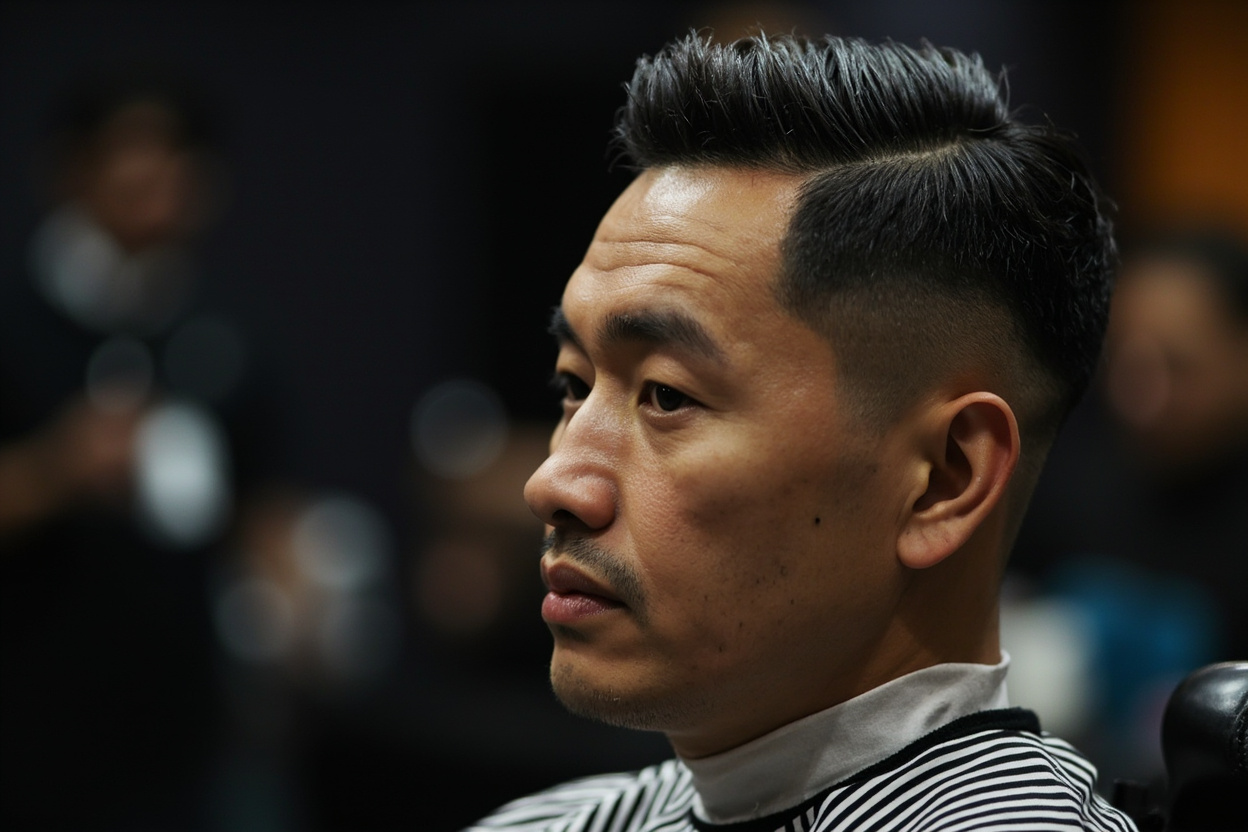
When recession happens at both temples but the center holds strong, you get a pronounced widow’s peak. Instead of fighting it, this style leans in: the top is kept two to three inches long and styled back or up from the peak, while tapered sides keep the outline clean. The peak becomes a natural focal point that reads as a strong, masculine hairline — think of it as nature’s pompadour anchor. The styling directs all volume from the peak backward, so the temple recession sits in shadow. Clients with this pattern are often surprised when I tell them they have one of the easiest hairlines to style around.
Best For
- Face Shape: Oval, square, heart (the peak suits angular features)
- Hair Type: Straight or wavy, medium density in the center
- Hair Length: 2-3 inches on top
- Age Range: All ages
- Occasion: Office, formal, everyday
Maintenance & Styling
- Touch-up: Every 3-4 weeks
- Styling Time: 3-4 minutes
- Products Needed: Matte clay, light hairspray
- Difficulty: Medium
How to Ask Your Barber
Say: “Keep the length through the center and style it back from the widow’s peak. Taper the sides clean, and blend the temples soft — don’t try to square off the hairline.”
Pro tip from my salon: Never let a barber “even out” a widow’s peak with a razor. Shaving the peak creates a straight hairline that recedes twice as fast visually, and the regrowth stubble draws the eye straight to your temples.
7. Faux Hawk
The faux hawk turns your remaining hair into the main event and makes recession part of the design.
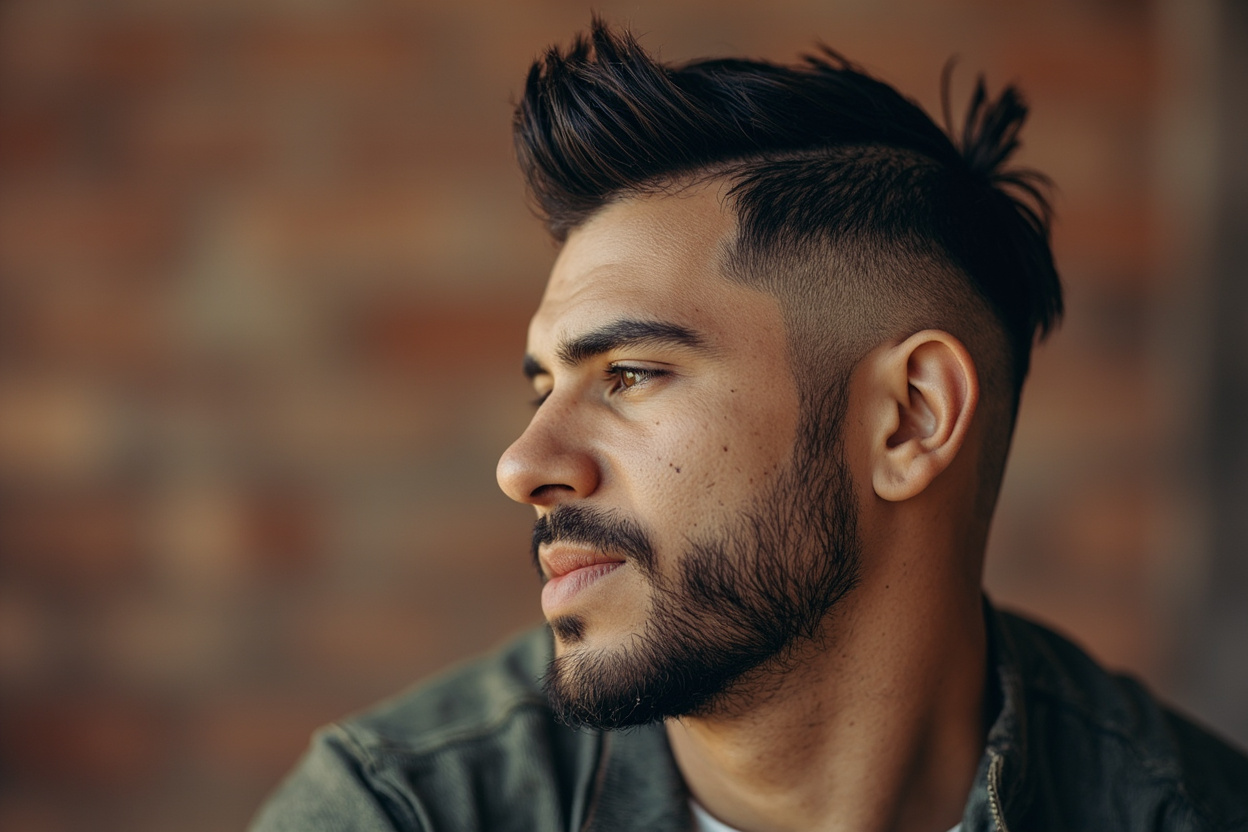
By concentrating length along the center of the head and fading the sides, the faux hawk creates a vertical line of volume that pulls every eye upward and inward — away from the temples. Unlike a true mohawk, the transition is gradual, so it stays workplace-appropriate. This cut is tailor-made for temple recession because the thinning areas fall exactly where the fade goes anyway. What would be a flaw in a longer style becomes clean, faded scalp in this one. Push the center up and slightly forward with matte clay, and the silhouette adds an inch of visual height, which is a bonus for round faces.
Best For
- Face Shape: Round, oval, square
- Hair Type: Straight, wavy, or curly
- Hair Length: 2-3 inches in the center strip
- Age Range: 20s-40s
- Occasion: Casual, social, creative workplaces
Maintenance & Styling
- Touch-up: Every 3 weeks
- Styling Time: 4-5 minutes
- Products Needed: Matte clay, texturizing spray
- Difficulty: Medium
How to Ask Your Barber
Say: “Faux hawk with a mid skin fade on the sides. Leave the center longer front to back, and blend it so I can spike it up or wear it flat for work.”
Pro tip from my salon: Warm the clay between your palms for a full ten seconds before applying. Cold, clumpy product separates thin hair and shows scalp; warmed product coats evenly and builds thickness.
8. Regulation Cut
The regulation cut is the sharpest-looking compromise between a buzz cut and a full-length style.

A military standard for generations, the regulation cut pairs tightly tapered sides with a short, side-parted top of about an inch. The result is disciplined and deliberately neat, which is exactly the impression you want thinning hair to give. The short top length keeps fine hair standing at attention, while the defined side part adds structure that distracts from a soft hairline. Unlike a true side part with length, there’s not enough hair here to flop or separate over the recession. This is the cut I suggest to clients in law, finance, and medicine who want zero risk and maximum polish.
Best For
- Face Shape: Oval, square, rectangle
- Hair Type: Straight or slightly wavy
- Hair Length: About 1 inch on top
- Age Range: All ages
- Occasion: Professional, formal, military
Maintenance & Styling
- Touch-up: Every 2-3 weeks
- Styling Time: 2 minutes
- Products Needed: Light pomade, comb
- Difficulty: Easy
How to Ask Your Barber
Say: “Regulation cut — clean taper on the sides down to the skin at the neckline, an inch on top with a hard side part. Keep the part line natural, not razored in.”
Pro tip from my salon: Ask for the part on the side where your hair naturally falls. Forcing a part against your growth pattern exposes scalp along the part line, which is the last thing thinning hair needs.
Best Hairstyles for a Thinning Crown
A bald spot at the crown needs a different playbook: keep length that flows backward over the crown, and avoid cuts that leave it exposed.
9. Slicked Back Taper
Slicking your hair back sounds counterintuitive for hair loss, but for crown thinning it’s a genuine cheat code.

When your hairline is strong but your crown is thinning, directing three to four inches of top length straight back creates a continuous sheet of hair that lays right over the bald spot. The trick is using matte product instead of the traditional wet-look gel — shine separates hair into strands and lets scalp peek through, while matte texture keeps the coverage looking dense. Tapered sides keep the shape from getting bulky. This style works best in the earlier stages of crown thinning, while there’s still enough hair to bridge the gap. Once the spot outgrows the coverage, transition to style 21 or 22 on this list.
Best For
- Face Shape: Oval, oblong, square
- Hair Type: Straight or wavy, medium to thick in front
- Hair Length: 3-4 inches on top
- Age Range: 30s-60s
- Occasion: Office, formal, evenings
Maintenance & Styling
- Touch-up: Every 4-5 weeks
- Styling Time: 5 minutes
- Products Needed: Matte pomade, blow dryer, vent brush
- Difficulty: Medium
How to Ask Your Barber
Say: “Keep three to four inches on top so I can slick it straight back over my crown, and give me a low taper on the sides. Don’t thin out the top — I need the density for coverage.”
Pro tip from my salon: Blow-dry backward with a vent brush before any product touches your hair. Heat-setting the direction does ninety percent of the work, so you only need a small amount of pomade — and less product means less separation over the crown.
10. Classic Side Part
The classic side part remains the most elegant way to redistribute hair over a thinning crown.

Parting your hair on the side lets you sweep the bulk of your top length diagonally across the head, which covers more scalp per inch of hair than any straight-back style. The diagonal line also breaks up the visual field, so the eye follows the part instead of hunting for thin areas. Keep the top two to three inches and the sides neatly tapered. This is not the see-through comb over we all fear — the difference is honesty about scale. A side part redirects hair a few natural inches; a bad comb over drags ten inches of hair across a bald head. Stay on the right side of that line and this style is timeless.
Best For
- Face Shape: Oval, round, heart
- Hair Type: Straight or gently wavy
- Hair Length: 2-3 inches on top
- Age Range: All ages, especially 40+
- Occasion: Business, formal, everyday
Maintenance & Styling
- Touch-up: Every 3-4 weeks
- Styling Time: 3-4 minutes
- Products Needed: Light matte cream, comb
- Difficulty: Easy
How to Ask Your Barber
Say: “Classic side part, two to three inches on top, tapered sides and back. Part it on my natural side and show me where that is if I’m not sure.” Any good barber can find your natural part in ten seconds by pushing damp hair forward and watching where it splits.
Pro tip from my salon: Part your hair while it’s damp, then dry it in place. Trying to carve a part into dry, thinning hair lifts hairs out of formation and opens gaps you don’t want.
11. Short Comb Over with Temple Fade
The modern comb over fade is proof that the word “comb over” doesn’t have to be an insult.

This contemporary take keeps two inches on top swept cleanly to one side, with a sharp temple fade carving out the sides. The fade is what makes it work for balding men: by taking the temples down to skin, it erases the thin spots entirely and replaces a fuzzy, receding edge with a crisp gradient. The combed top then sits over the crown area with enough direction to cover early thinning. It’s polished enough for the boardroom and current enough for a night out. We covered twenty variations of this look in our comb over fade haircuts guide if you want to compare fade heights before your next barber visit.
Best For
- Face Shape: Oval, square, rectangle
- Hair Type: Straight or wavy
- Hair Length: About 2 inches on top
- Age Range: 20s-50s
- Occasion: Business, smart casual, dates
Maintenance & Styling
- Touch-up: Every 2-3 weeks (fades grow out fast)
- Styling Time: 3-4 minutes
- Products Needed: Matte pomade, comb
- Difficulty: Medium
How to Ask Your Barber
Say: “Short comb over with a temple fade — take the temples down to skin, leave about two inches on top, and blend the transition soft. Comb direction toward my thinner side.”
Pro tip from my salon: Always comb toward the thin area, not away from it. Hair combed away from thinning exposes the roots at the part line, which is exactly where crown thinning shows first.
12. Textured Quiff
The textured quiff builds a wall of volume at the front that makes the whole head read as full.

A quiff sweeps the front upward and back, creating height right where your hairline lives. For men with a strong front but a thinning crown, this is ideal: the eye locks onto the tallest point of any silhouette, and a quiff puts that point at your forehead, a good six inches from your crown. Texture matters more than polish here — a loose, matte, slightly messy quiff hides density issues that a tight, glossy one would broadcast. Keep three to four inches up front, shorter through the crown, with tapered sides. When clients tell me they want to “look like they have more hair” without a dramatic cut, the quiff is usually my answer.
Best For
- Face Shape: Round, oval, heart (height slims round faces)
- Hair Type: Straight, wavy, fine to medium
- Hair Length: 3-4 inches in front
- Age Range: 20s-50s
- Occasion: Everyday, social, business casual
Maintenance & Styling
- Touch-up: Every 4 weeks
- Styling Time: 5-7 minutes
- Products Needed: Sea salt spray, blow dryer, matte clay
- Difficulty: Requires skill
How to Ask Your Barber
Say: “Textured quiff — three to four inches at the front, gradually shorter to the crown, low taper on the sides. Texturize the top so it holds volume without heavy product.”
Pro tip from my salon: Blow-dry the quiff up and back on medium heat with a cool-shot finish. The cool air locks the lift in place, so fine hair holds its height all day instead of collapsing by lunch.
13. Short Pompadour with Fade
The short pompadour delivers old-school confidence scaled down to thinning-hair-friendly proportions.
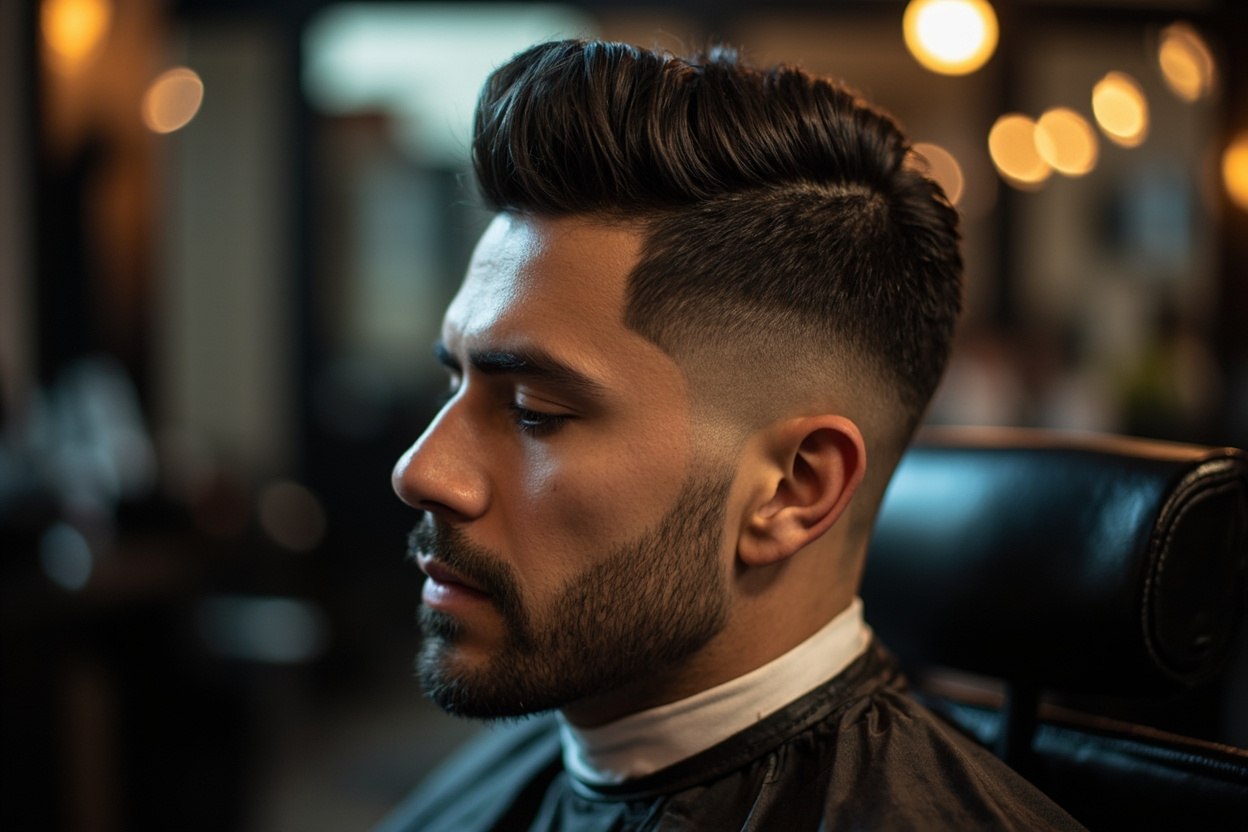
A full rockabilly pompadour needs more density than most balding men have, but the short version — two to three inches swept up and back with a mid fade — captures the attitude without demanding the hair. The volume concentrates at the front hairline, the sweep covers the mid-scalp, and the fade removes the temples from the conversation entirely. Compared to the quiff, the pompadour is rounder and more uniform, which suits formal settings. Use a matte paste with medium hold; the classic high-shine pomade look is the enemy of thin hair because shine reveals separation.
Best For
- Face Shape: Oval, round, heart
- Hair Type: Straight or wavy, medium density up front
- Hair Length: 2-3 inches in front
- Age Range: 20s-50s
- Occasion: Formal, business, evenings out
Maintenance & Styling
- Touch-up: Every 3 weeks
- Styling Time: 5 minutes
- Products Needed: Matte paste, blow dryer, round brush
- Difficulty: Requires skill
How to Ask Your Barber
Say: “Short pompadour with a mid fade. Keep two to three inches at the front, blend it shorter toward the crown, and make sure I can brush it up and back without it flopping.”
Pro tip from my salon: Style the pompadour in three small sections — left, center, right — instead of one big sweep. Sectioned styling overlaps the hair like roof shingles, and that overlap is what hides a thinning crown underneath.
14. Disconnected Undercut
The disconnected undercut uses hard contrast on the sides to make the top look thicker by comparison.
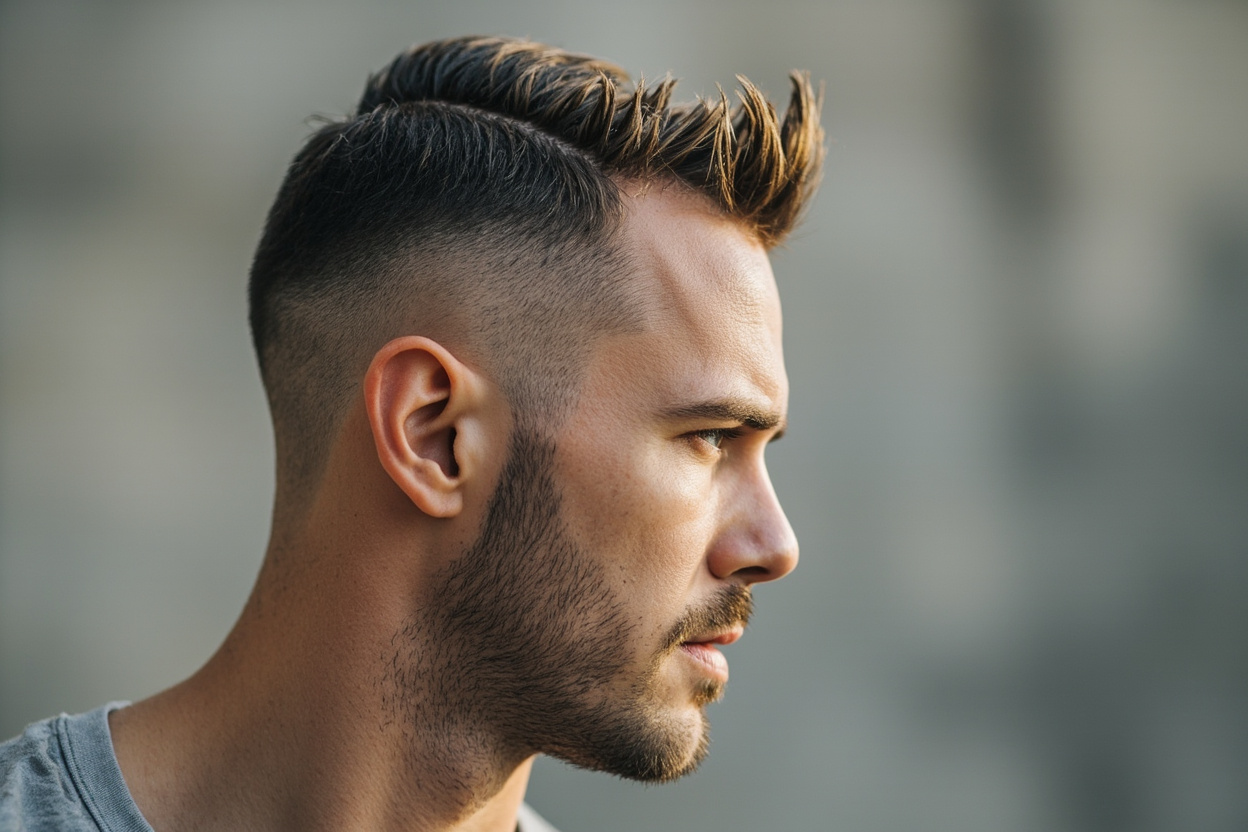
Here the sides are clipped to a uniform short length with no blending, while the top stays three or more inches long, usually slicked back or to the side. That sharp disconnection line creates an optical illusion: against nearly-shaved sides, even moderate density on top reads as a thick mane. This works best for men whose thinning is concentrated at the crown while the top-front still grows strong. Fair warning from experience — this style has a shelf life. As crown thinning progresses, the long top starts showing gaps, so treat the undercut as a great “stage one and two” style rather than a forever cut.
Best For
- Face Shape: Oval, square, oblong
- Hair Type: Straight, wavy, thick-on-top
- Hair Length: 3+ inches on top, #1-2 sides
- Age Range: 20s-40s
- Occasion: Creative, social, fashion-forward
Maintenance & Styling
- Touch-up: Every 2-3 weeks
- Styling Time: 4-5 minutes
- Products Needed: Matte pomade, blow dryer
- Difficulty: Medium
How to Ask Your Barber
Say: “Disconnected undercut — #2 on the sides with a clean disconnection line, no blend. Leave the top long enough to slick back over my crown.”
Pro tip from my salon: Ask your barber to check your crown density every visit. The undercut hides early thinning brilliantly, but there’s a point where a shorter, blended cut takes over — catching that transition early keeps you looking sharp, not stubborn.
Best Hairstyles for Overall Thinning Hair
When density drops across the whole head rather than in one spot, uniform short cuts with built-in texture are the winning formula.
15. High and Tight
The high and tight is the buzz cut’s sharper, more structured cousin — and it’s brutal on thinning hair in the best way.
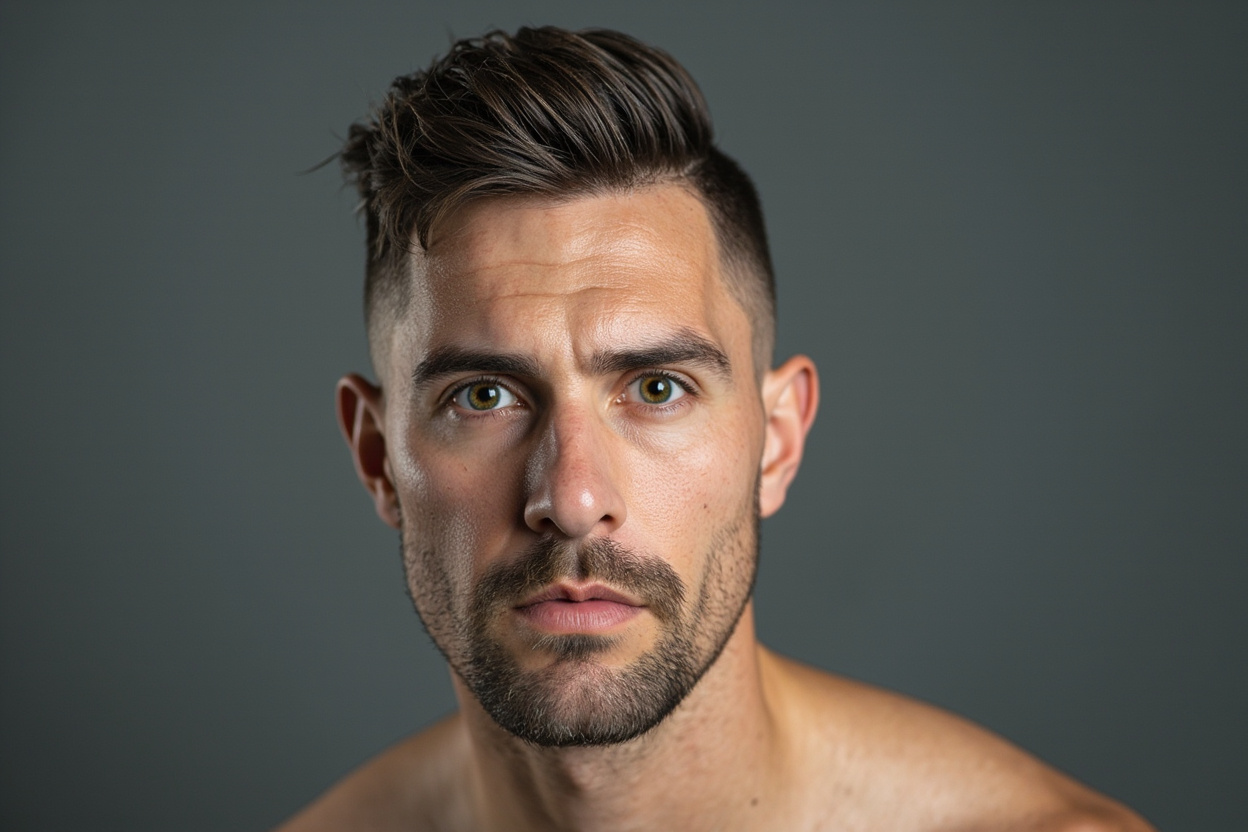
Shaved or skin-faded sides climb high on the head, leaving only a short patch of length across the top. Because the remaining top hair is confined to the densest zone of most heads, the style showcases your best hair and removes your worst. The high contrast also reads as deliberate and disciplined — nobody looks at a high and tight and thinks “hair loss.” They think military, athletic, intentional. It’s a two-minute morning routine and it photographs beautifully from every angle, which matters more than most men admit.
Best For
- Face Shape: Oval, square, angular
- Hair Type: All textures
- Hair Length: ½-1 inch on top, skin on sides
- Age Range: All ages
- Occasion: Athletic, professional, everyday
Maintenance & Styling
- Touch-up: Every 2 weeks
- Styling Time: 0-1 minute
- Products Needed: Optional light matte cream
- Difficulty: Easy
How to Ask Your Barber
Say: “High and tight — skin on the sides up past the temples, and leave a half inch to an inch on top. Blend just the top edge so it’s not a hard shelf.”
Pro tip from my salon: If your overall thinning includes the top, ask for a “high and tight recon” variation where the top is taken down to a #2. Uniformly short top hair hides low density far better than patchy half-inch length.
16. Ivy League
The Ivy League is what happens when a crew cut gets a graduate degree.

Slightly longer than a crew cut — around one and a half inches on top — the Ivy League adds just enough length for a soft side part while keeping everything short enough to disguise dropping density. It’s the most versatile professional cut on this list: part it for meetings, mess it up for weekends, brush it forward if your hairline needs cover. Scissor-cut rather than clipped, it grows out evenly and never has an awkward phase. For men over forty juggling gray blending and thinning at the same time, this cut handles both gracefully, since salt and pepper hair at short lengths naturally masks scalp show-through.
Best For
- Face Shape: Oval, round, heart, rectangle
- Hair Type: Straight or wavy
- Hair Length: 1-1.5 inches on top
- Age Range: All ages, shines at 35+
- Occasion: Business, formal, everyday
Maintenance & Styling
- Touch-up: Every 3-4 weeks
- Styling Time: 2-3 minutes
- Products Needed: Light matte cream
- Difficulty: Easy
How to Ask Your Barber
Say: “Ivy League cut, scissor work on top — about an inch and a half, tapered sides, long enough at the front to part it or brush it forward.”
Pro tip from my salon: Request scissors over clippers for the top. Scissor cutting leaves varied lengths that layer over each other and build visual density, while clipper-uniform hair lies flat and shows scalp in bright light.
17. Butch Cut
The butch cut splits the difference between a buzz cut and a crew cut, and for many thinning heads it’s the sweet spot.
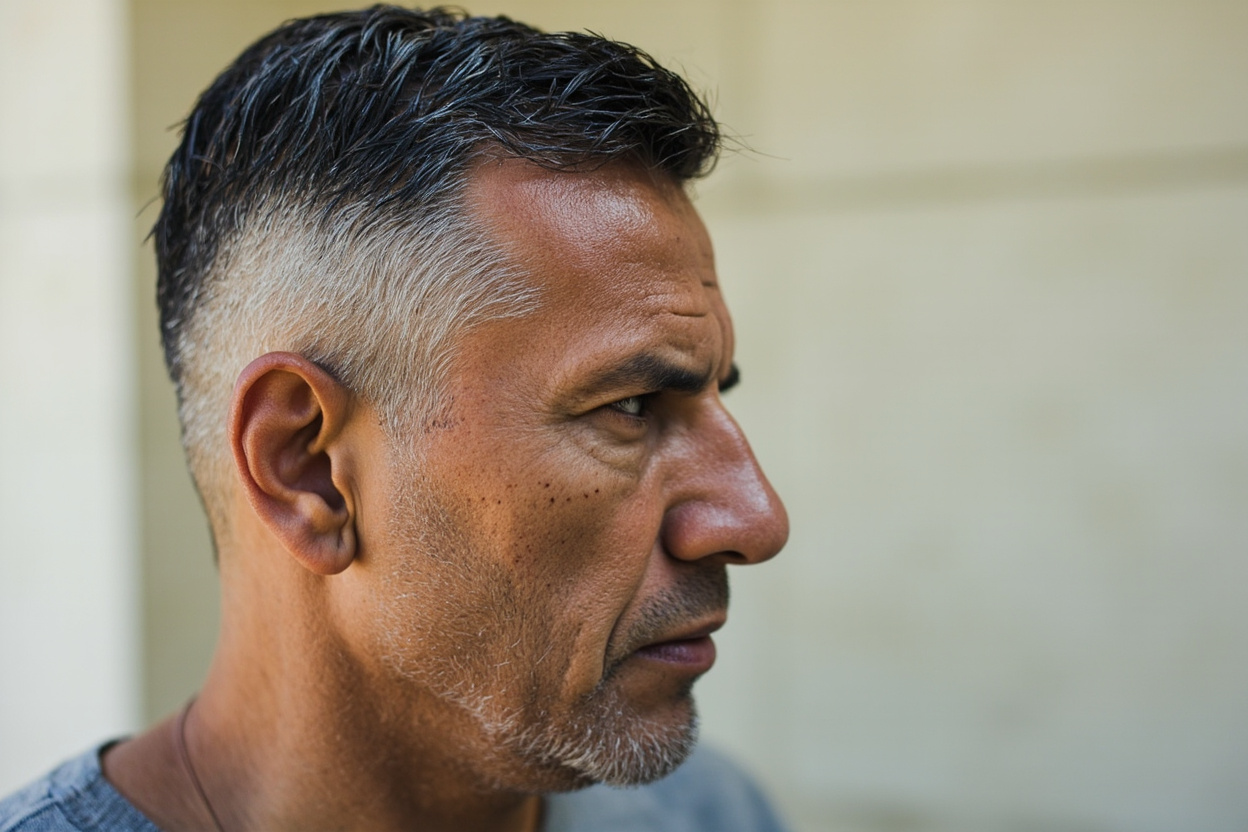
Clipped to a uniform half inch or so all over, the butch keeps enough length to show your hair color and texture while staying short enough that density differences vanish. It’s a touch softer than a buzz cut, which suits men who find a full buzz too severe for their features or their workplace. The uniform length means it grows out evenly and forgives a missed barber appointment better than any fade. If your thinning is diffuse — a little everywhere rather than one obvious spot — the butch cut is arguably the most flattering length physics will allow.
Best For
- Face Shape: Oval, square, round
- Hair Type: All textures
- Hair Length: #3-4 guard (½ inch) all over
- Age Range: All ages
- Occasion: Everyday, athletic, low-maintenance
Maintenance & Styling
- Touch-up: Every 3-4 weeks
- Styling Time: 0 minutes
- Products Needed: None; scalp sunscreen outdoors
- Difficulty: Easy
How to Ask Your Barber
Say: “Butch cut — #3 or #4 guard all over, tapered edges at the neckline and around the ears. Keep the hairline natural.”
Pro tip from my salon: A weekly scalp scrub matters more than any styling product at this length. Healthy, flake-free scalp under short hair reads as youthful; a dry scalp under a butch cut ages you five years.
18. Brush Up with Spiky Texture
Spiking thin hair upward is a volume trick barbers have relied on for decades, and it still works.
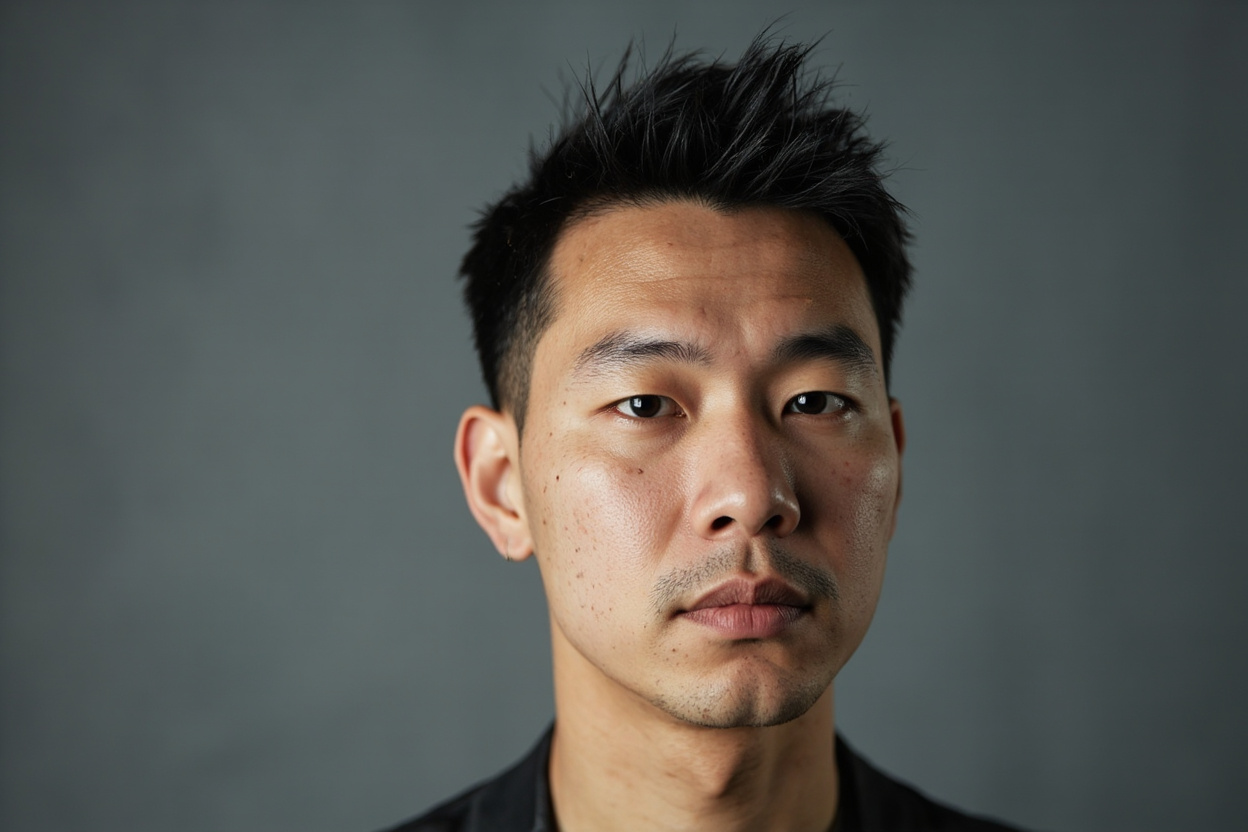
When hair stands vertically, you see its full length as volume; when it lies flat, you see the scalp beneath it. The brush up exploits this by styling two inches of top hair straight up with a matte texturizing product, supported by tapered or faded sides. Deliberate separation between spikes reads as edgy texture — but keep the spikes soft and irregular, not gelled into hard points. Hard, glossy spikes are one of the classic thinning-hair mistakes because shine plus separation equals visible scalp. Done matte and messy, this cut takes years off and pairs especially well with fine, straight hair that refuses to hold other styles.
Best For
- Face Shape: Round, oval, heart
- Hair Type: Straight, fine to medium
- Hair Length: 1.5-2 inches on top
- Age Range: 20s-40s
- Occasion: Casual, social, creative
Maintenance & Styling
- Touch-up: Every 3-4 weeks
- Styling Time: 4 minutes
- Products Needed: Texturizing powder or matte wax
- Difficulty: Medium
How to Ask Your Barber
Say: “Short brush up — about two inches on top with choppy texture, low fade on the sides. I want to spike it up messy, not gelled.”
Pro tip from my salon: Work product from the back of your head forward. Most men start at the front, which overloads the hairline with wax and flattens the exact hair that needs the most lift.
19. Short Curly Cut
Curly hair is a built-in advantage for balding men — every curl is a natural volumizer.

Curls occupy three-dimensional space, casting shadows and overlapping in ways straight hair can’t, which makes low density remarkably hard to spot. The short curly cut keeps one to two inches of natural curl on top with a taper or low fade on the sides. The critical detail is moisture: dry, frizzy curls separate and reveal scalp, while hydrated, defined curls clump together and cover. A curl cream or light leave-in conditioner is non-negotiable here. For coily textures, a sponge-twist finish adds even more coverage. If your curls are loosening as thinning progresses, keep shortening the cut to match — tight and short always beats long and stringy.
Best For
- Face Shape: Oval, oblong, square
- Hair Type: Curly and coily textures
- Hair Length: 1-2 inches on top
- Age Range: All ages
- Occasion: Everyday, professional, social
Maintenance & Styling
- Touch-up: Every 3-4 weeks
- Styling Time: 3 minutes
- Products Needed: Curl cream, leave-in conditioner
- Difficulty: Easy
How to Ask Your Barber
Say: “Cut it dry or damp so you can see my curl pattern — one to two inches of curl on top, low taper on the sides, and shape the top round, not flat.”
Pro tip from my salon: Never brush curls out when styling this cut. Scrunch curl cream into damp hair and let it air dry — brushing stretches curls flat and undoes every bit of natural coverage they give you.
20. Bro Flow
The bro flow is the one longer style I’ll green-light for early-stage thinning — with conditions.

Swept back and worn loose at four to six inches, the bro flow works when your thinning is subtle and evenly distributed, because the relaxed waves layer over each other and hide sparse patches. It projects confidence precisely because it looks unbothered. The conditions: your hairline must still be reasonably intact, your hair needs some natural wave, and you have to commit to volumizing shampoo and weekly conditioning, since limp, flat length is the fastest way to advertise thinning. Think of the bro flow as a style you enjoy during Norwood stages one and two, with a graceful exit plan to a shorter cut when the time comes.
Best For
- Face Shape: Oval, square, rectangle
- Hair Type: Wavy, medium density, early thinning only
- Hair Length: 4-6 inches
- Age Range: 20s-40s
- Occasion: Casual, creative, social
Maintenance & Styling
- Touch-up: Every 6-8 weeks
- Styling Time: 5 minutes
- Products Needed: Volumizing shampoo, sea salt spray, light conditioner
- Difficulty: Medium
How to Ask Your Barber
Say: “Keep the length but add long layers so it flows back naturally. Light texturizing through the top for volume — don’t thin it out with thinning shears.”
Pro tip from my salon: Flip your part once a month. Hair parted in the same spot for years wears a widening line into the scalp, and alternating sides keeps the roots lifted and the part line dense.
Best Hairstyles for Advanced Balding
When coverage is no longer realistic, these five styles trade camouflage for confidence — and they’re often the best-looking options on this entire list.
21. Skin Fade with Short Top (Bald Fade)
The bald fade is the most modern answer to advanced thinning, blending what’s gone with what remains.
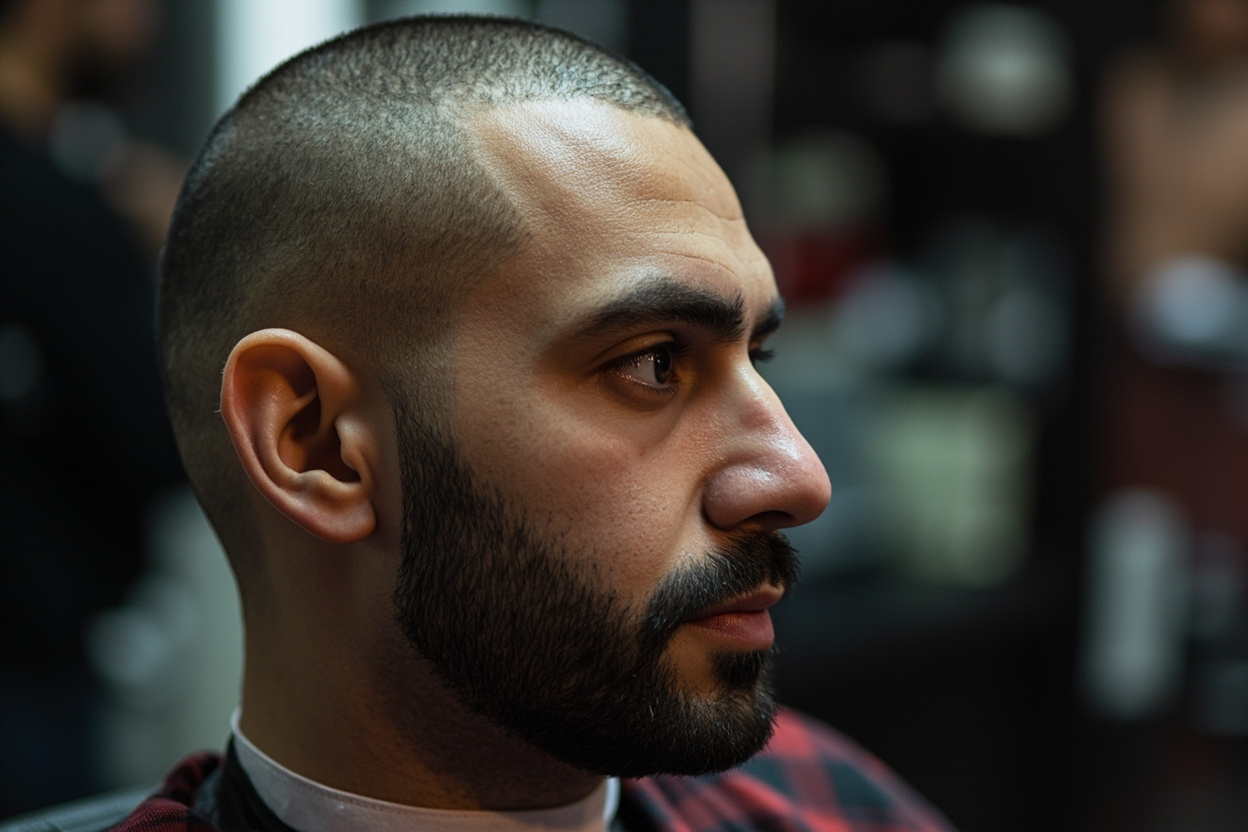
A skin fade takes the sides and back down to bare skin, then blends upward into whatever short length your top can support — even just a shadow of stubble. Because the fade makes shaved skin part of the design, a bald crown or deep recession simply merges into the haircut. There’s no boundary between “bald” and “hair,” so the eye can’t find the hair loss. This is the cut I recommend when clients aren’t ready for a full shave but their coverage days are behind them. It requires frequent upkeep, but the payoff is a genuinely sharp, current look at any Norwood stage. Our low taper fade guide shows how the same blending logic works at lower fade heights.
Best For
- Face Shape: All shapes
- Hair Type: All textures
- Hair Length: Skin to ½ inch
- Age Range: All ages
- Occasion: Everyday, professional, athletic
Maintenance & Styling
- Touch-up: Every 1-2 weeks
- Styling Time: 0 minutes
- Products Needed: Scalp moisturizer
- Difficulty: Easy to wear, needs a skilled barber
How to Ask Your Barber
Say: “Skin fade on the sides and back, blended into whatever length works with my thinning on top — probably a #1 or #2. Make the transition seamless so the thin crown disappears into the fade.”
Pro tip from my salon: Book your next fade appointment before you leave the shop. A skin fade looks flawless for ten days, and the men who look sharp year-round are simply the ones on a standing two-week schedule.
22. Clean Shave
Sometimes the best hairstyle for a balding man is no hair at all — and science backs that up.
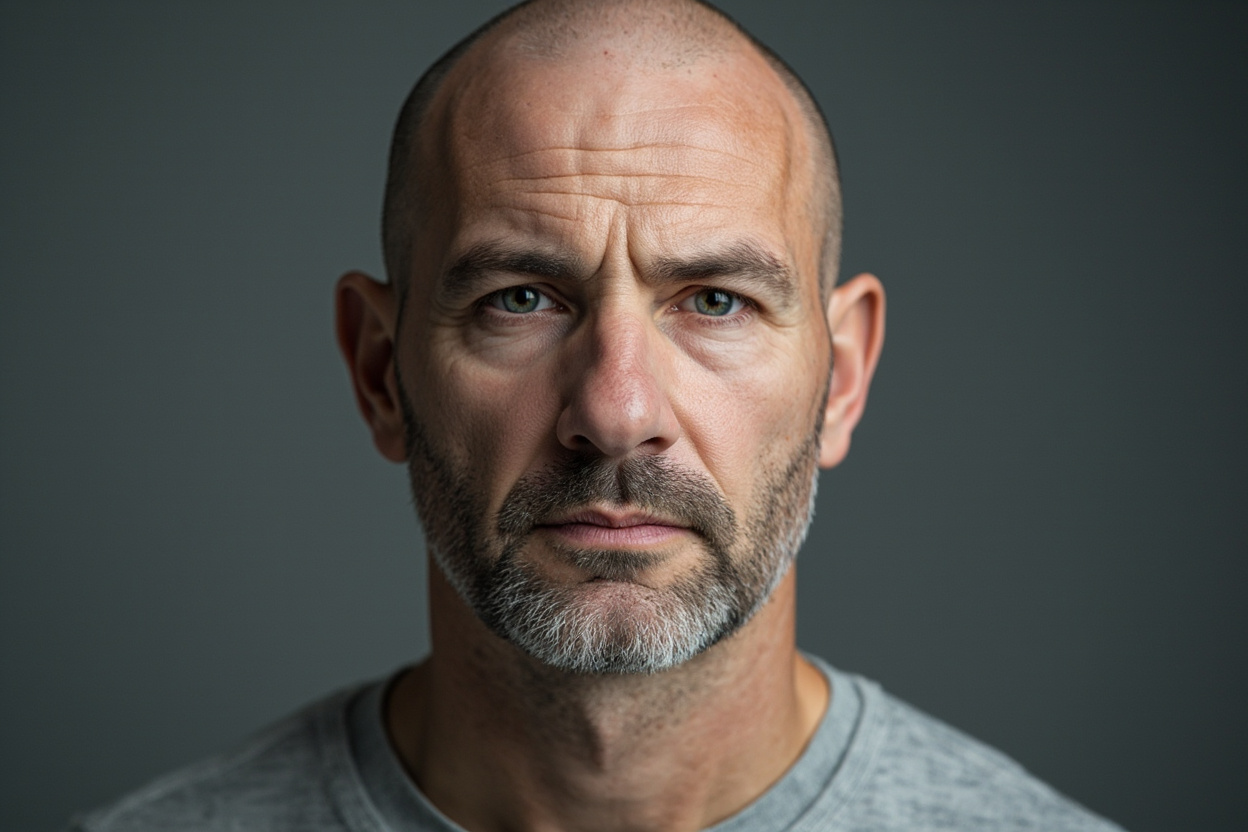
A University of Pennsylvania study found that men with shaved heads were rated as more dominant, taller, and stronger than men with visibly thinning hair. That matches what I see in the chair: the clean shave removes all ambiguity and replaces “losing his hair” with “chose this look.” It flatters strong brows, defined jaws, and well-shaped heads, and it pairs with everything from a suit to gym clothes. The maintenance shifts from hair to skin — razor or foil shaver every day or two, moisturizer, and daily SPF, because your scalp becomes year-round sun-exposed skin. Before committing, shave down to a #0 guard first to preview your head shape.
Best For
- Face Shape: Oval, square, angular; strong jawlines excel
- Hair Type: Any (or none)
- Hair Length: Zero
- Age Range: All ages
- Occasion: Universal
Maintenance & Styling
- Touch-up: Shave every 1-3 days at home
- Styling Time: 0 minutes
- Products Needed: Razor or head shaver, moisturizer, SPF 30+
- Difficulty: Easy
How to Ask Your Barber
Say: “Take it all off — full head shave with a straight razor finish.” For the first time, let a barber do it: a professional shave with hot towels teaches you the direction your hair grows so you can maintain it at home without irritation.
Pro tip from my salon: Moisturize your scalp every single night for the first month. Freshly shaved scalps often flake and shine unevenly at first, and consistent moisture is what produces that healthy, matte, even-toned bald look.
23. Shaved Head with Full Beard
The shaved head and full beard combination might be the most flattering “hairstyle” on this entire list.
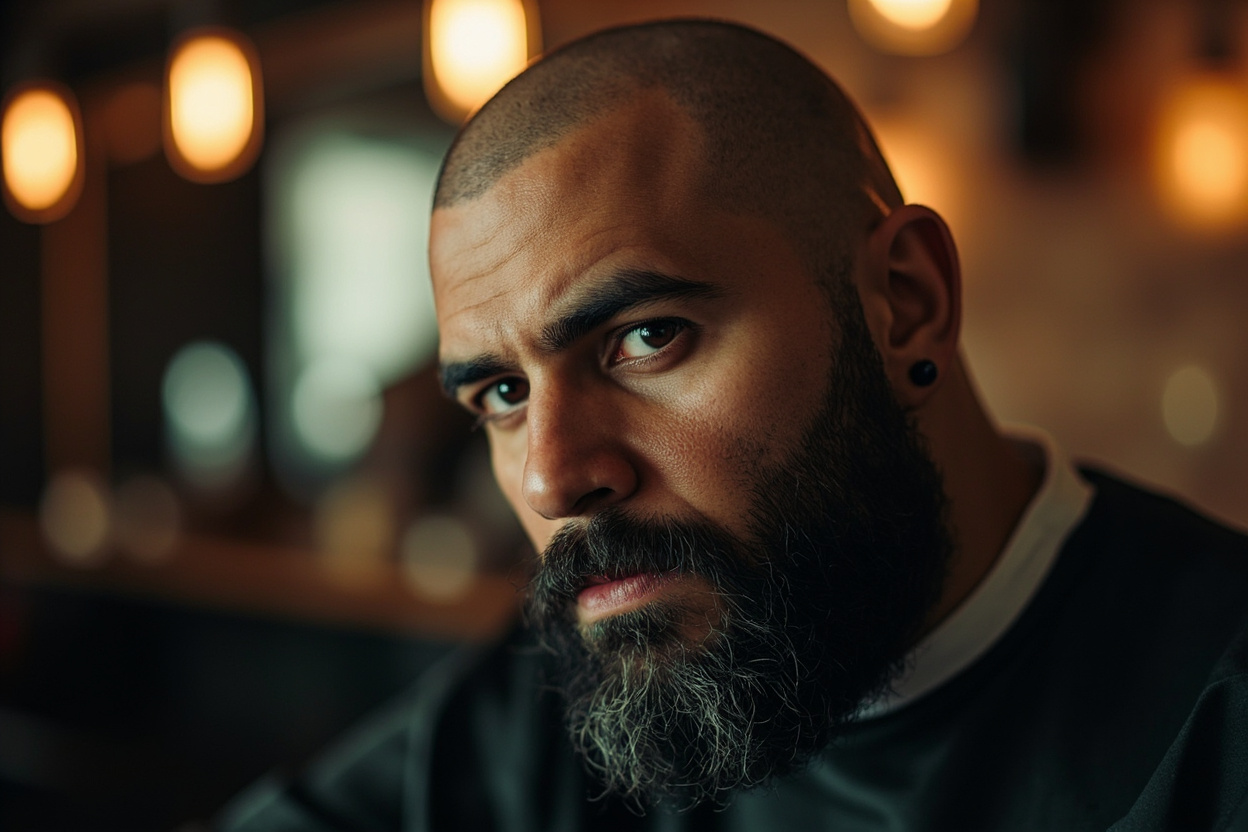
Moving the visual weight from your scalp to your jawline reframes your entire face. A dense, well-shaped beard restores the frame that a receding hairline takes away, balances the proportions of the head, and gives you something to groom and style — so you never feel like you gave up on grooming, just relocated it. Keep the cheek lines natural and the neckline crisp, about two fingers above the Adam’s apple. Even three weeks of stubble shifts the effect dramatically; think Jason Statham rather than lumberjack if a full beard isn’t in your genetics. This combo works across every age group and nearly every professional setting.
Best For
- Face Shape: All; especially round and heart (beard adds jaw definition)
- Hair Type: Any scalp hair; medium to dense beard growth
- Hair Length: Shaved or #0-1 scalp, ½-2 inch beard
- Age Range: 25+
- Occasion: Universal
Maintenance & Styling
- Touch-up: Scalp every 1-3 days, beard shape-up every 2-3 weeks
- Styling Time: 3-4 minutes (beard oil and brush)
- Products Needed: Beard oil, beard brush, scalp moisturizer, SPF
- Difficulty: Easy
How to Ask Your Barber
Say: “Head shave with a razor finish, and shape the beard — natural cheek line, tight neckline two fingers above the Adam’s apple, and blend the sideburn transition into the shave.”
Pro tip from my salon: Ask for a “beard fade” at the sideburns, where the beard gradually shortens as it meets the shaved scalp. That blended transition is what separates an intentional look from a man who just stopped cutting his hair.
24. Salt and Pepper Textured Taper
For men over fifty dealing with thinning and graying at once, the textured taper turns both into assets.
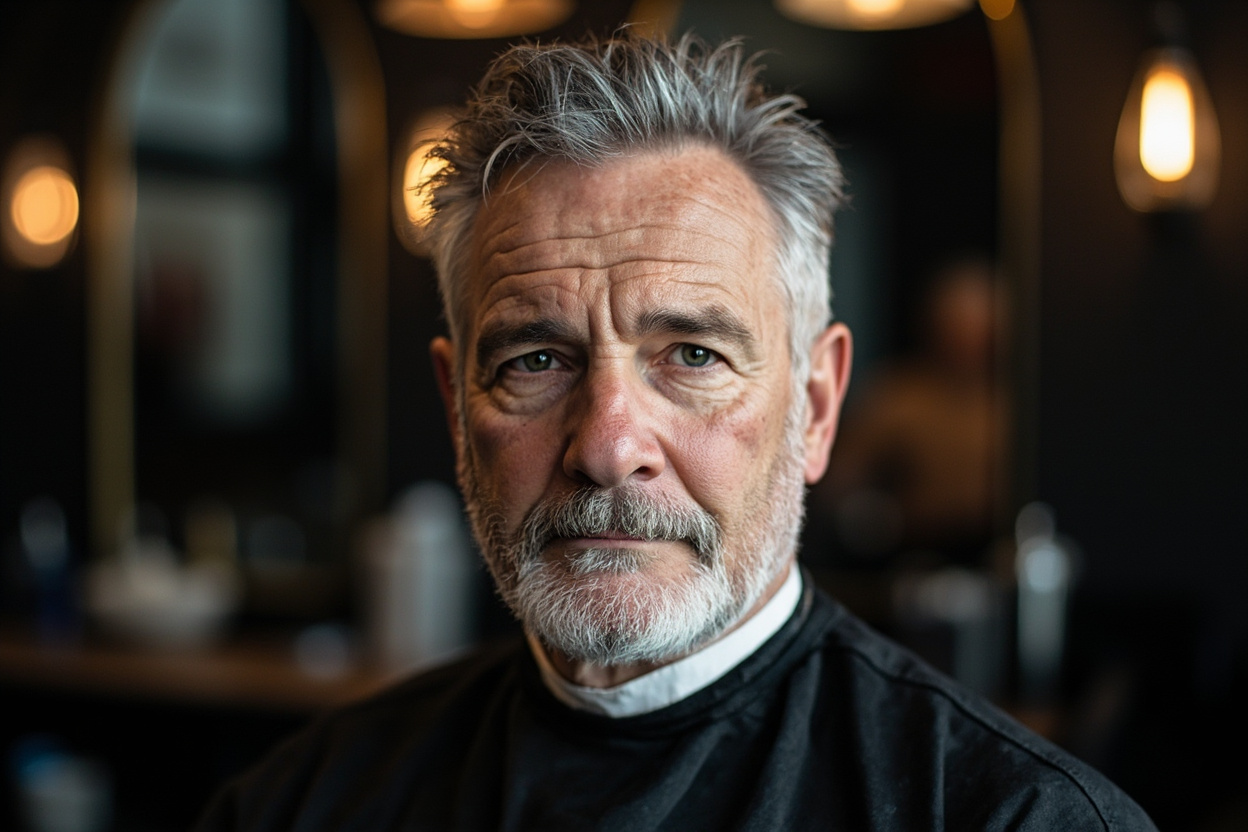
Gray hair is coarser and often wavier than pigmented hair, which means it holds texture and volume better than the hair you had at thirty. This cut uses that: one to two inches of textured length on top, scissor-cut for layering, over a classic tapered side. The mixed silver-and-dark tones naturally camouflage scalp show-through, because the varied colors break up the visual field the same way camouflage patterns do. I tell my older clients to stop fighting the gray — dyed, thinning hair looks flat and uniform, which is the worst combination for coverage. Distinguished beats disguised, every time.
Best For
- Face Shape: All shapes
- Hair Type: Straight, wavy, graying
- Hair Length: 1-2 inches on top
- Age Range: 45+
- Occasion: Business, formal, everyday
Maintenance & Styling
- Touch-up: Every 4 weeks
- Styling Time: 2-3 minutes
- Products Needed: Matte cream, purple shampoo weekly (keeps gray bright)
- Difficulty: Easy
How to Ask Your Barber
Say: “Classic taper on the sides, scissor-cut texture on top around an inch and a half. Leave the gray natural and cut for volume, not flatness.”
Pro tip from my salon: Swap your regular shampoo for a purple-toned one once a week. Bright, clean silver reads as a style choice; yellowed gray reads as neglect — and perception is half of what a great haircut does for you.
25. Executive Business Cut
The executive cut is the quiet professional of balding hairstyles — nobody notices it, which is exactly the point.

Short tapered sides, one to two inches on top with a soft side part, everything scissor-blended and conservative. What makes the executive version balding-friendly is restraint: no hard part lines etched near thin areas, no high-contrast fades that spotlight the hairline, no product shine. The cut simply presents your hair at its tidiest and lets your face do the talking. It’s the style I give attorneys, surgeons, and executives who tell me, “I don’t want anyone thinking about my hair — including me.” Paired with a good tailor, this cut has quietly carried men through boardrooms for a century.
Best For
- Face Shape: All shapes
- Hair Type: Straight or wavy
- Hair Length: 1-2 inches on top
- Age Range: 30+
- Occasion: Corporate, formal, client-facing work
Maintenance & Styling
- Touch-up: Every 3-4 weeks
- Styling Time: 2 minutes
- Products Needed: Light matte cream, comb
- Difficulty: Easy
How to Ask Your Barber
Say: “Executive business cut — scissor taper on the sides, inch and a half on top with a soft natural part. Conservative, no hard lines, no skin fade.”
Pro tip from my salon: Ask your barber to leave the top a quarter inch longer than looks perfect in the chair. Business cuts photograph and function best at day four, and that little buffer keeps you polished for the full month.
5 Hairstyles Balding Men Should Avoid
After a decade of fixing haircut mistakes, these are the five styles I talk clients out of every single month.
- The see-through comb over. Dragging long hair across a bald area fools nobody and fails in the first breeze. If your comb over needs hairspray to survive a walk to the car, it’s time for style 11’s short, faded version instead.
- The power doughnut. Leaving a ring of untouched length around a bald crown maximizes contrast — the exact opposite of what thinning hair needs. A taper or fade solves it in one appointment.
- Long hair with a bald crown. Length at the sides and back with nothing on top pulls the eye straight to the contrast. Gravity always wins this fight.
- Sparse gelled spikes. Heavy gel clumps thin hair into separated strands with scalp visible between them. Swap gel for matte powder or clay and half the problem disappears.
- The forward “wisp curtain.” Growing a thin fringe long to cover a deep forehead reads as camouflage. A short, dense, deliberately cut fringe — like styles 3, 4, and 5 — covers more and looks chosen.
The common thread: every mistake tries to stretch too little hair too far. Every winning style on this list does the opposite — it concentrates hair where it’s dense and removes it where it’s not.
Styling Rules for Thinning Hair
The right cut is half the battle; these habits are the other half.
- Go matte, always. Shine reveals scalp; matte texture conceals it. Clay, paste, and powder beat gel and glossy pomade for balding men in every situation.
- Less product than you think. A pea-sized amount, warmed between palms, applied back-to-front. Overloading fine hair weighs it flat and undoes your cut.
- Blow-dry for volume. Thirty seconds of upward blow-drying at the roots adds more visible thickness than any product. Finish with cool air to lock it in.
- Wash smart. A volumizing or thickening shampoo three to four times a week keeps fine hair from going limp, and a weekly scalp exfoliation keeps follicles clear.
- Protect your scalp. Short cuts expose skin. Daily SPF on visible scalp prevents the sun damage that ages bald and balding heads fastest.
- Consider treatment early. Styling hides thinning; it doesn’t stop it. If you want to keep your options open, talk to a dermatologist about proven treatments like minoxidil and finasteride — the American Academy of Dermatology’s hair loss guidance is the right place to start reading.
Which Style Is Right for You?
If you’ve skimmed this far, here’s the sixty-second decision guide I’d give you in my chair.
| Your Situation | Best Pick | Backup Pick | Touch-up |
|---|---|---|---|
| Receding hairline, want styling | Textured Crop (#3) | Caesar Cut (#4) | 3-4 weeks |
| Receding hairline, want simple | Buzz Cut (#1) | Crew Cut (#2) | 2-3 weeks |
| Thinning crown | Slicked Back Taper (#9) | Comb Over Fade (#11) | 3-4 weeks |
| Overall thinning | High and Tight (#15) | Butch Cut (#17) | 2-3 weeks |
| Advanced balding | Skin Fade (#21) | Shaved Head + Beard (#23) | 1-2 weeks |
| Over 50, graying | Salt & Pepper Taper (#24) | Ivy League (#16) | 3-4 weeks |
Whichever direction you choose, commit to it fully. The men who look best with hair loss are never the ones with the most hair — they’re the ones whose haircut looks like a decision.
Frequently Asked Questions
What is the best haircut for a balding man?
The buzz cut is the most universally flattering choice because it minimizes contrast between thinning and full areas. If you want more styling options, a textured crop hides a receding hairline, while a skin fade blends advanced balding seamlessly into the cut.
Should balding men keep their hair short?
Yes, in almost every case. Short hair reduces the contrast between dense and thin areas, stands upright for more visible volume, and looks intentional. Long hair over thinning areas separates, falls flat, and exposes scalp — especially in wind, rain, or bright light.
Do fades help thinning hair look thicker?
They do. A fade removes the thinnest hair at the temples and sides entirely, replacing soft, patchy edges with a clean gradient. Against skin-faded sides, the remaining top hair reads as denser by comparison. It’s the most effective optical trick in modern barbering.
How can I hide a receding hairline?
Style hair forward over the hairline with a textured crop, Caesar cut, or messy fringe. A soft, broken fringe line conceals temple recession completely. Avoid slicking hair back off a receding hairline unless the recession is minimal and your crown needs the coverage more.
Should I just shave my head?
Shave when maintaining remaining hair costs more effort than it returns — usually once the crown and hairline merge. Test it first with a #0 buzz to preview your head shape. Research shows shaved heads read as more dominant and confident than visibly thinning hair.
How do I know if I’d look good bald?
Strong jawlines, defined brows, and smooth, even head shapes suit a full shave best. Buzz your hair to a #0 or #1 guard as a low-risk preview, and grow light stubble or a beard — facial hair balances nearly every head shape and softens the transition.
What hairstyles should balding men avoid?
Avoid see-through comb overs, long hair surrounding a bald crown, sparse gelled spikes, and thin wispy fringes grown for coverage. All four stretch too little hair over too much area, which highlights hair loss instead of hiding it. Concentrated, short, matte-textured styles always win.
What products work best for thinning hair?
Use matte products only: clay, paste, or texturizing powder for hold, plus sea salt spray for volume. A thickening shampoo helps fine hair stand fuller. Skip gels and glossy pomades — shine separates thin hair into strands and makes scalp visible underneath.
Final Thoughts
Hair loss is something that happens to you; your haircut is something you choose. That difference is the entire secret behind every great style on this list. The 25 hairstyles for balding men above all follow the same three rules I teach every client: reduce contrast, add texture, and cut with intention.
Start with your hair loss pattern, use the comparison table to shortlist two styles, and take this article to your barber — the “how to ask” scripts under each cut will get you exactly what you see here. And if your hair loss progresses, don’t cling to an old style; move down this list gracefully. There’s a sharp, confident cut waiting at every single stage.